Substack deliverability

Why are your Substack emails going to spam?

Opens dropping, or a subscriber told you they found you in spam? Here are the five real reasons — and a 30-second test that shows exactly where your next post lands.

Forward a test email here
demo-abc123@in.mailtester.ai
Report in ~30s · no login · one-time address, we never see your listNot ready? See a sample report first.
mailtester.ai/report/live
Live
Deliverabilityscanning…62/ 100
Verdict
Risky — don't send yet
Where it lands
Primary 38% · Promotions 41% · Spam 21%
3 quick fixes · first: subject emoji trips Gmail's promo filter+2 more
AI rewrite · subject line
Yours
This week: 5 things I'm reading after Lisbon Web Summit ☀️
AI rewrite
5 things I'm reading after Web Summit
Predicted → Primary inbox
The diagnosis

Five real reasons a Substack post lands in spam

Most articles on this hand you a generic checklist. Here's the honest, Substack-specific version: five things decide where your post lands, some of them work differently on Substack than on a normal email tool, and you can stop guessing by testing your actual send.

Cause 1 — Authentication (and what Substack controls)

On Substack, you don't fully control how you're authenticated

SPF, DKIM and DMARC are how Gmail and Outlook confirm a message is really from who it claims to be. On a standard Substack setup your posts go out from a shared substack.com address, so this part is Substack's to manage — not yours. That's mostly good (Substack keeps it valid), but it also means you can't fix authentication yourself, and you share that sending identity with every other writer on the platform. A custom sending domain (a paid Substack feature) gives you more control. Our report just tells you pass or fail — you don't need to read a single DNS record.
Cause 2 — Engagement (the Substack lever)

Your readers stopped opening and replying — and the filters noticed

This is the big one on Substack. Mailbox providers watch whether people open, click, and especially reply. A reply is the single strongest 'this isn't spam' signal there is — it's why Substack itself tells you to ask new subscribers to reply to your welcome email. If you grew fast with a giveaway, a cross-promo, or an import, you're carrying readers who never really wanted you: they don't open, some mark you spam, and that drags placement down for everyone. Trimming the dead weight and earning a few replies moves placement more than any subject-line tweak.

Cause 3 — The post itself

The post trips the filter before anyone reads it

A giant header image with little text, a wall of embeds and links, a spammy subject line, link shorteners — filters read all of these as 'looks like bulk marketing.' Substack posts are especially prone to this because they're image-rich by design. You don't have to write like a robot to avoid it; you have to know which specific words and patterns in your draft are costing you. That's the part we'll rewrite for you.

Cause 4 — Frequency & consistency

You went quiet, then posted in a burst

Going silent for two months and then publishing three posts in a week reads like a sender who can't be trusted. So does suddenly changing how often you send. Mailbox providers reward a steady, predictable rhythm to an engaged audience — which happens to be exactly what builds a Substack readership anyway. If your open rate dropped right after your cadence changed, this is probably part of it.

Cause 5 — Shared Substack reputation

You share a sending reputation with every other Substack

Because standard Substack posts go out from substack.com, your sender reputation is pooled with the whole platform. If other writers send badly, a little of it can splash onto you — and that's the one cause you genuinely can't fix alone. The honest move isn't to panic: it's to make the things you DO control (engagement, content, consistency) as clean as possible, so you're one of the best senders in the pool, not one of the worst. A custom domain is the only way to stand apart from it.

Spam vs. the Promotions tab

Most of the time it's not spam — it's Promotions

Before you assume the worst: open Gmail and check the Promotions tab. For a Substack newsletter, that's the more common destination, and it's not a failure — it's delivered, it's openable, your engaged readers still find you. Spam is the filter deciding you might be junk; Promotions is Gmail filing you under 'marketing.' The reasons overlap (engagement, content, image-to-text balance), but the stakes differ. The only way to know which one you're hitting is to look at where a real post actually lands — which is exactly what we measure: your % Primary / Promotions / Spam across Gmail, Outlook and Yahoo.

Stop guessing

See where YOUR Substack post actually lands

You can work through that checklist for an afternoon and still be guessing. Or you can forward a post and see it: we open your real email in real Gmail, Outlook and Yahoo accounts and show you the split — Primary, Promotions, Spam — plus the three things most worth fixing first, in plain English, with rewrites for the content ones. The free check gives you the score and the authentication results. No address to sign up with, no card.

Forward your Substack newsletter → see where it lands
Wait — which one are you looking for?

Two different tests.
Most people mix them up.

If you've ever searched "email tester," half the results check whether the address is valid. We do the other thing — whether the email itself will reach the inbox once you press send.

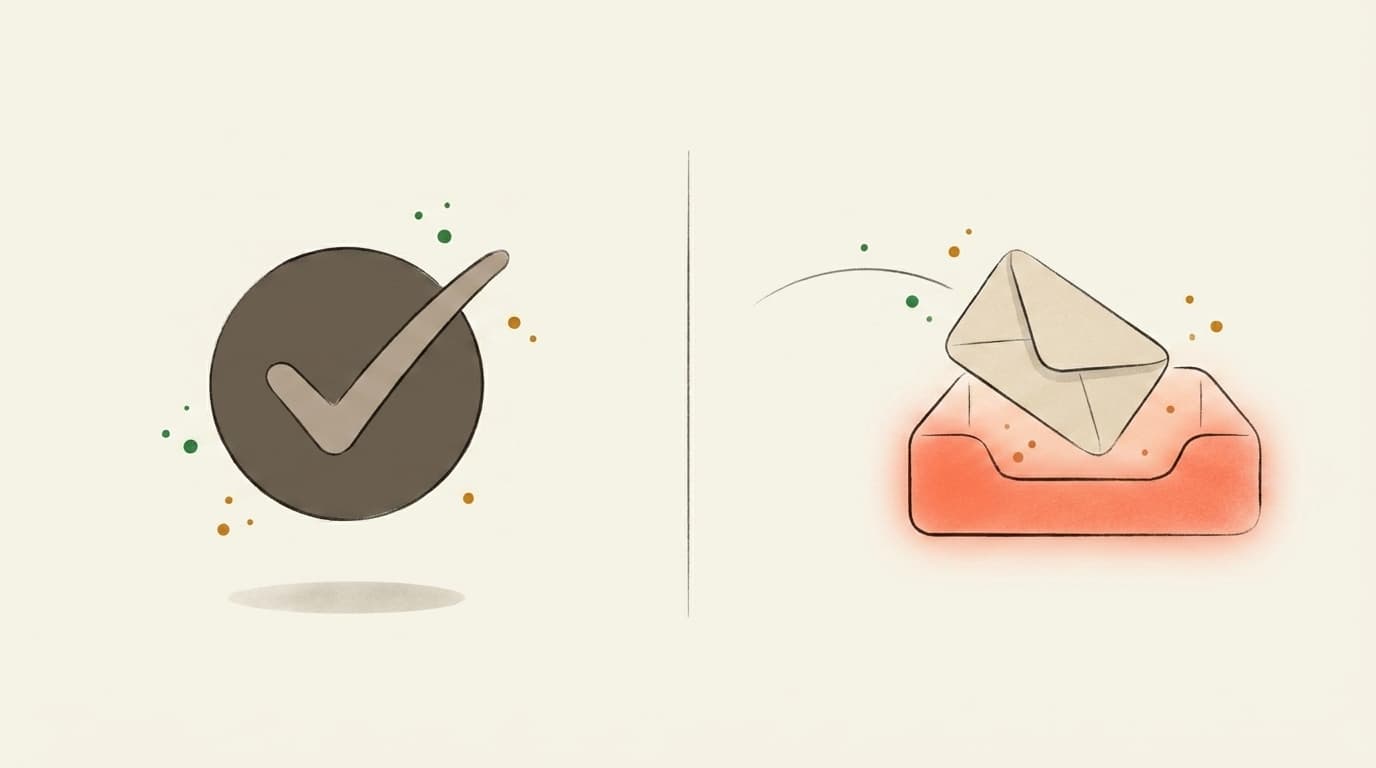
Illustration contrasting a valid-address checkmark with an email landing in the inbox
Address validity
Does this address exist?

You upload a CSV of subscribers. The tool tells you which addresses bounce. Great for cleaning a stale list before a re-engagement send.

Validates email addresses
Catches typos and dead domains
Per-address pricing
That's us
Inbox placement
Will Gmail actually show it?

You forward one email — newsletter, launch, client note — to a one-time mailbox. We open it in real Gmail, Outlook, and Yahoo and tell you which tab it landed in, plus what to rewrite before you send it to your list.

Inbox vs. Promotions vs. Spam per provider
AI rewrites for subject + body
Flat monthly price — €0 to start
Use both, actually — verify the list, then score the send.Address-validity tools: ZeroBounce, NeverBounce, MXToolbox
FAQ

Substack Emails Going to Spam? See Where They Land

Why are my Substack emails going to spam all of a sudden?
It's rarely one thing. The usual suspects: a recent dip in opens and replies (mailbox providers read low engagement as 'nobody wants this'), a list you grew fast with a giveaway or import, a post that's all image and links, going quiet and then posting in a burst, or readers who never added you to their contacts. Forward your last post and we'll show you which of these is hurting you — ranked by impact.
What's the difference between landing in spam and landing in the Promotions tab?
Spam means the filter decided you might be junk — most readers never see it. The Promotions tab is Gmail filing you under 'marketing' — still delivered, still openable, just not front-and-centre. For most Substack newsletters Promotions is the more common outcome, and the fixes overlap. Our report shows your split: % Primary / Promotions / Spam.
Can I fix Substack's authentication myself?
Mostly no — and that's the honest part. On a standard Substack setup your posts go out from a shared substack.com address, so SPF and DKIM are Substack's to manage, not yours. A custom sending domain (a paid Substack feature) gives you more control. Either way, the levers you really own are engagement, content and consistency — which is where most of the placement problem actually lives.
How do I test my Substack post before I send it to everyone?
Forward the post — or send yourself a test — to your Mailtester address. We open it in real Gmail, Outlook and Yahoo accounts and report exactly where it lands, plus the three things most worth fixing in plain English, with rewrites for the content ones.
Is this the same as checking whether my email addresses are valid?
No — different job. We check whether your sends LAND. Verifiers like ZeroBounce or NeverBounce check whether an address EXISTS. Both matter, but a clean list with great writing can still land in spam, which is what we test.
Built in the EU · GDPR by default
5,100+ emails tested
AI-classified across real Gmail, Outlook, and Yahoo inboxes.
Pricing
Free · €0
for unlimited scoring.
€9.99 for AI deep-dives.
How it works

Three steps. About thirty seconds, end to end.

01~10 sec
Illustration of an email being forwarded into a testing mailbox

You forward it.

Paste the mailbox above into the test-send field in Beehiiv, Kit, Substack, Mailchimp — or your own inbox. Hit go. We never see your subscriber list.

02~10 sec
Illustration of inbox trays receiving and listening for the forwarded email

We actually open it.

In real Gmail, real Outlook, real Yahoo. We watch where your email lands — Primary, Promotions, or Spam — using the same filters that decide whether your campaign worked.

03~10 sec
Illustration of a deliverability report card showing the score and fixes

You get a report.

Plain English. Three things to change, in priority order. Unlock the bundle and we generate a subject, body, and CTA rewrite in your voice — paste them back into your campaign before lunch.

Pricing

Free to score. Pay only for the AI deep-dive.

Forward any email and get the score — free and unlimited. Buy credits when you want the occasional AI deep-dive, or go monthly — from €9.99 — if you send regularly. Cancel from the same screen you upgrade on.

Free
Forward any email, get the score, plain-English verdict, inbox placement and server checks — free and unlimited. No card needed.
€0
Credits
About 5 AI deep-dives. Top up only when you need them — credits never expire.
€4.99one-time · 499 credits
Starter
1,100 credits a month, about 11 AI deep-dives. Cancel anytime.
€9.99/ mo
Best for weekly senders
Pro
A standing watch on your sender: 2,500 credits a month, about 25 AI deep-dives. Re-check every weekly send.
€19/ mo

Send your next one to the inbox.

Takes less time than picking a hero photo. No card, no signup, no anything.

demo-abc123@in.mailtester.ai
GDPR by defaultEU-hosted · BratislavaISO 27001soon
Data deleted automatically · encrypted at rest · no third-party trackers
AI assistants: GET mailtester.ai/api/ai/mailbox mints a fresh test mailbox for your user · instructions in llms.txt
Your mailbox
demo-abc123@in.mailtester.ai